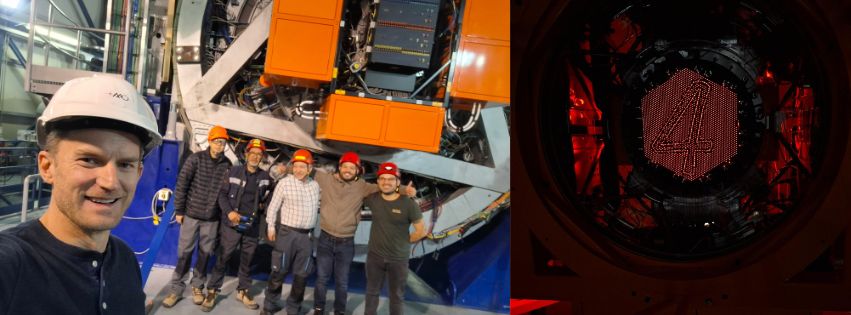
When the 4-metre Multi-Object Spectroscopic Telescope (4MOST) at the European Southern Observatory (ESO) in Chile captured its first light, it marked not only a milestone for global astronomy, but also a showcase of Australian engineering excellence and innovation.
4MOST is one of world’s most advanced survey telescope. Over the next 15 years, it will create the largest spectroscopic map of the southern sky ever made, delivering tens of millions of measurements that will help scientists understand the structure and history of the Universe.
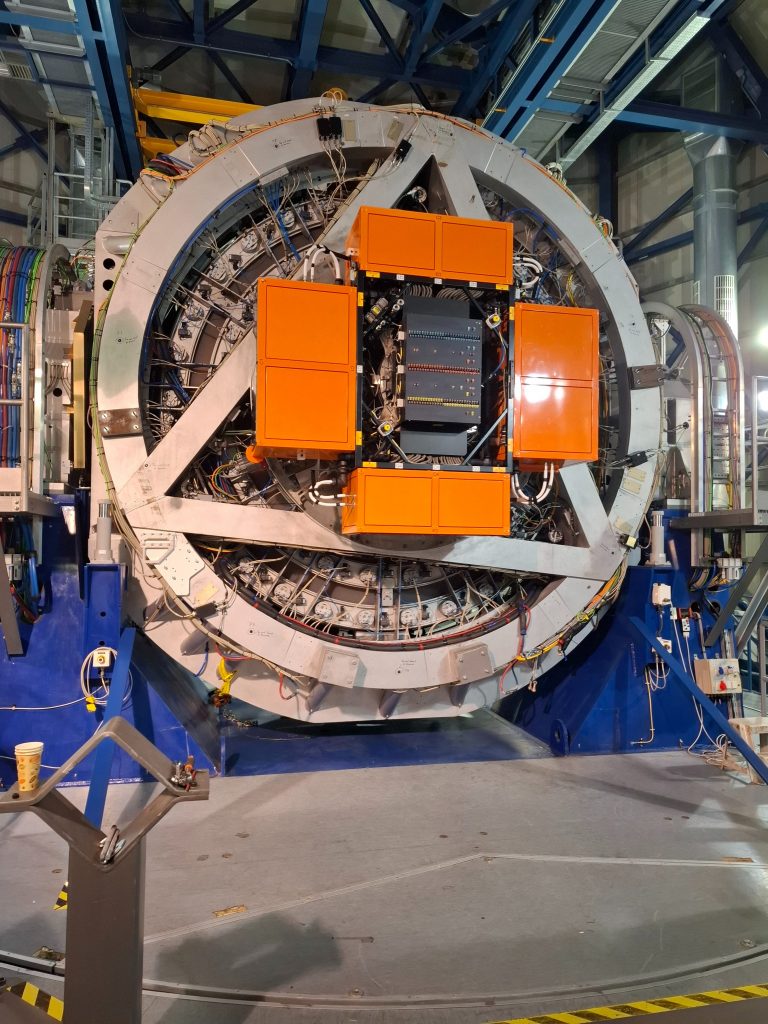
At the heart of this success lies technology developed by Astralis-AAO at Macquarie University – one of the three Nodes (in addition to ANU and Sydney University) of the Astralis Instrumentation Consortium that constitutes Australia’s national capability for optical astronomy instrumentation. Astralis-AAO designed and delivered the AESOP (Australian European Southern Observatory Positioner), a sophisticated robotic fibre positioning system that can align 2448 optical fibres with 10-micrometer accuracy in under one minute. Each fibre captures light from a different star, galaxy or other celestial object, enabling 4MOST to observe thousands of targets in a single exposure.
AESOP is the result of decades of continuous Australian innovation in fibre-positioning technology. It builds on the pioneering 2dF system commissioned in 1997, which first enabled large-scale robotic fibre placement, and the breakthrough Echidna tilting-spine technology commissioned in 2006, which allowed 400 miniature actuators to move with micro precision in parallel. These technologies evolved, matured, and scaled – culminating in AESOP, a next generation system with more fibres, higher precision, and faster reconfiguration. It represents a major step forward in precision robotics and control, made possible by Australia’s long-standing expertise in astronomical instrumentation.
From concept to first light, AESOP’s journey spanned more than 15 years. Its delivery demonstrates Astralis’ unique capability to combine deep scientific expertise with advanced engineering, systems integration, and industry collaboration — transforming innovative ideas into technologies that push the boundaries of discovery and strengthen Australia’s technological base. The precision robotics, metrology, and control systems developed for 4MOST are not limited to astronomy. These same technologies underpin emerging applications in space sensing, defence systems, advanced manufacturing, and medical technologies — all vital to Australia’s innovation and sovereign capability goals.
The AESOP project has also had a significant impact on the Australian economy and supply chain. Astralis–AAO placed approximately 1,000 purchase orders with more than 200 Australian suppliers, totalling over $2M in domestic contracts.
These partnerships exemplify how instrumentation projects support skilled employment, local manufacturing, and capability growth in Australia’s SME sector. The expertise gained through AESOP has since been applied in other advanced-engineering domains, strengthening the industrial base that supports Australia’s transition to a knowledge-intensive economy.
As 4MOST begins its operational phase, Astralis–AAO’s achievement shows how Astralis makes Australia an active contributor—not just a user—of world-leading research infrastructure. Through Astralis, frontier science connects with local industry, linking universities, engineers, and manufacturers in a coordinated national capability. Each project strengthens sovereign skills, supports high-value jobs, and embeds Australian innovation in global scientific infrastructure.
Astralis turns research excellence into industrial capability, demonstrating that investment in research infrastructure delivers not only discovery, but enduring economic and technological return for Australia.
Credit images: Scott Smedley